A Farming System Rooted in Resilience
Before the Seed Goes In: A Field School in Makanyaneng
Scope of work
Field Work
,
MFS Training
Location
Makanyaneng, Butha-Buthe
Impact
Nine farmers, one field
Activity
Before the Seed Goes In: A Field School in Makanyaneng
On the 27th of August, the MADF (mophato) team made its way to Makanyaneng, in Butha-Buthe, for a Field School on planting potatoes — one of the oldest lessons in the Machobane Farming System, and still one of the ones farmers ask for most.
As always, the class opened the way these classes have opened for generations: Hymn No. 14 - (insert the title of the hymn) from the Lifela tsa Sione, and a prayer. Then everyone walked out to the field.
Nine farmers, one field
The training took place at the field of 'Me Mathabo Mabotsane, with nine people standing in the sun to learn — five registered MADF farmers and four neighbours who had simply heard there was something worth watching and came to see for themselves. Between them, they had already done half the work: bags of ash and manure, collected ahead of time, waiting at the edge of the field.
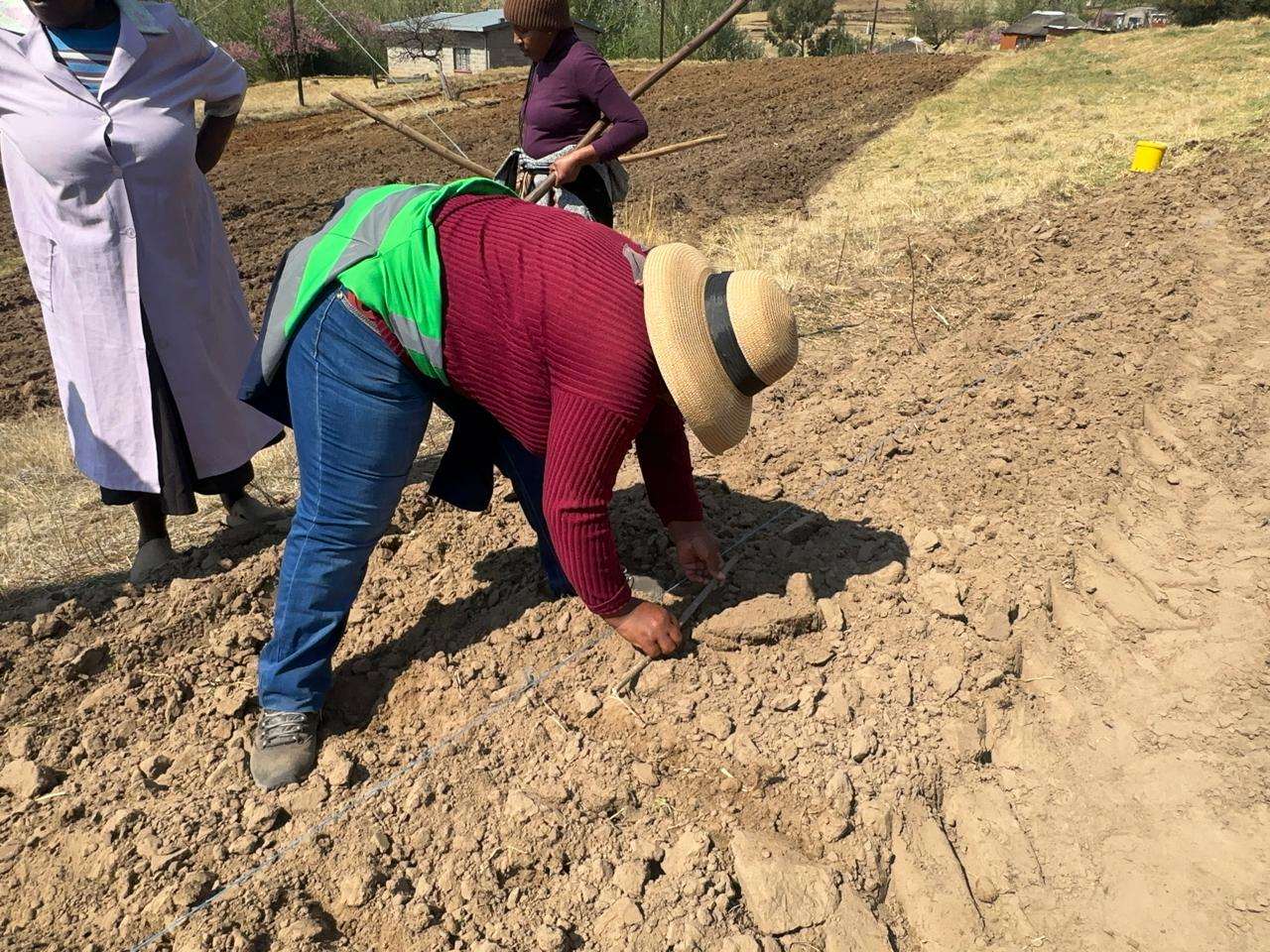
'Me Nora, MADF's trainer, started where every planting season should start — not with the seed, but with the ground. Where does the first line go? How far in, from the edge of the field or “lekorota”? Get that wrong, and everything planted after it is lined wrong too.
Nkhono le Ntate-Moholo
The mix at the centre of it all has a name that makes farmers smile the first time they hear it: nkhono le ntate-moholo — grandmother and grandfather. Ash and kraal manure, measured out on their own, then mixed together until they're properly combined. It's a simple, local, low-cost way of feeding depleted soil, and it sits at the heart of MFS — no shop-bought fertiliser required, just what the household and the kraal already provide.
'Me Nora showed the farmers how much of each to measure, and let them do it themselves before moving on. That's the rule at every Field School: nobody just watches.
Straight [contour] lines, three hand-spans apart
Once the first line was set using string — khoele — pulled taut from one end of the field to the other, the real work began.
The planting holes are dug along that line, spaced three hand-spans apart (about 45cm) — close enough to use the land well, wide enough for a potato plant to grow properly.
Each planting hole is dug and the soil scooped out, to provide space for the nkhono-le-ntate-moholo mix to be added and properly worked in with the loosened soil rather than sitting on top of it.
The mix goes in first and is worked through the soil at the bottom of the hole. Only then does the potato go in.
It's covered — but not buried. Too much soil sitting on top is heavy, and a heavy blanket of soil is hard for a young potato to push through.
Farmers repeated the sequence, row after row, until 'Me Nora was satisfied they had it — measuring, digging, mixing, covering, on to the next.
Room for what comes next
Here is the part that makes MFS more than a way to plant potatoes: the rows themselves are spaced two hoe-lengths and two hand-spans apart — deliberately wider than the potato needs on its own. That gap isn't wasted ground. It's left open on purpose, for maize and beans to be planted between the potato rows later in the season.
One field, more than one crop, timed to share the same ground without competing for it. It's the same relay-cropping principle behind everything MADF teaches: make the most of a small plot, and never let the soil sit doing only one job when it could be doing two.
Leaving the field the way you found it
The last lesson of the day had nothing to do with planting at all. Once the rows were in, the farmers were shown to mark out their own footpath — the same track they'd walked in on — and use it again on the way out, rather than trampling fresh ground across the field.
It sounds small. It isn't. Freshly turned, freshly moistened soil compacts easily underfoot, and compacted soil is harder for a potato to grow in. If the rain comes, as it usually does, a field that's been walked on carelessly pays for it later. A few careful footsteps now save the harvest problem in a few months' time.
By the time the farmers had practised the full sequence on two lines on their own, everyone understood not just how to plant, but why each step mattered.
What comes next
Before the class ended, the mophato shared a bit of MADF's own story — how the Machobane Farming System came to be, what the organisation is trying to build in communities like Makanyaneng, and how anyone interested can become a member and join a Field School near them.
That's really the whole idea behind these afternoons in the field. MADF brings the training, the mentorship, and a way of thinking about the soil that's been tested here for generations. The farmers bring their land, their labour, and — as we saw again in Makanyaneng — their willingness to get their hands into the mix and try it themselves.
Nine people came to a field in Makanyaneng to learn where to place a first line. By the end of the afternoon, they knew how to read a whole season into it.
Interested in a Field School near you, or want to know more about becoming an MADF member? Get in touch — we'd love to have you in the next line.